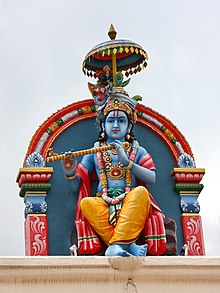
ORIGIN: Hindu (Epic and Puranic)[India]
TYPE: Incarnation of Visnu
KNOWN PERIOD OF WORSHIP: circa 300 BCE or earlier until present.
SYNONYMS: Kannan (Tamil). Many epithets.
CENTER(S) OF CULT: Generally throughout India, but particularly Mathura.
ART REFERENCES: Sculptures generally bronze but also stone. Reliefs
LITERARY SOURCES: Mahabharata epic, Bhagavad-Gita and Bhagavad-Purana
INFORMATION: Krsna is the eighth and arguably the most important incarnation or avatara of the god Visnu. He appears inauspiciously in the Vedic texts, but grows in stature and popularity. Allegedly born at Mathura on the bank of the river Yamuna, he is the son of Vasudeva and Devaki, fostered by Nanda and Yasoda. He is a deity who epitomizes human aspirations and shortcomings together. Thus he is both a Hindu divine hero, and a drinker and womanizer. He has no legal consort but his chief mistress , a married woman, is Radha. He is reputed to have enjoyed as many as 16,000 such liaisons.
Almost certainly, Krsna originated as a fertility god of herdsmen and vegetation who became syncretized with the hero of the Mahabharata epic. In the Bhagavata-Purana, Krsna is also perceived as the embodiment of the cosmos—the vault of heaven is his navel, the stars his chest, the sky his eyes.
Krsna's incarnation was, by tradition, designed to save the world from the demonic king Kansa. He is particularly worshiped as a baby (Balakrsna) and as a youthful shepherd accompanied by Radha. He is seen as a skilled musician often depicted playing the flute at the sound of which nature pauses to listen, storms are calmed, rivers flow calmly and maidens are roused.
The legends of Krsna's childhood depict him as a somewhat precocious child who plays tricks and ransacks kitchen jars of butter and curds. The incident with butter has been a popular theme for sculptures. As an adult he champions the struggle with the adversaries of mankind, the nagas, subduing the serpent Kaliya (See also Garuda). He may be seen standing on Garuda.
COLOR: Black or dark blue.
ATTRIBUTES: Flute, the hill of Govardhana on one finger, an ornament, prayer wheel, and shepherd's staff. He may, on occasion carry other objects.